
 ChatGPT
 Gemini
 Perplexity
 Google AI
 Claude
 Copilot
 Muse by Meta
 Grok
哪些问题里,有你的名字?
看清本次测试问了什么、品牌是否出现,以及哪些竞品进入了同一份答案。
示例买家问题
“Which bike shops in Austin offer e-bike test rides?”


面向美国市场的 SEO & AI 搜索
让产品优势,进入美国买家的考虑名单。从你的网站开始,找到值得优先改进的地方。
本次回答中的品牌提及
把试骑预约与维修范围,放到客户能找到的页面上。
虚构品牌与演示数据,用于展示报告结构。
买家的下一次搜索,
正在这些地方发生。
01 / 先看到,再决定
从一句买家提问,追到实际回答与来源。让每个建议,都能说清为什么。
看清本次测试问了什么、品牌是否出现,以及哪些竞品进入了同一份答案。
“Which bike shops in Austin offer e-bike test rides?”
展开原始回答,查看引用链接与检测时间。品牌被提及和官网被引用,分开呈现。
把发现落到具体页面、缺失信息与下一步工作。从最有价值的改进开始。
产品适用条件是否清楚?
对比问题有没有答案?
02 / 从发现,到落实
The Third 把 SEO、内容与 AI 搜索放进同一套工作里。从诊断到交付,每一步有明确的下一步。
围绕一个产品和美国买家场景,检查搜索呈现、页面信息与品牌事实。
改进英文产品页、对比内容与技术基础,补齐买家需要的证据和可信来源。
记录做了什么,按相同范围复测;结合有效询盘与业务反馈,决定下一轮重点。
03 / 从你的客户出发
你的产品、市场与客户,决定我们先回答哪些问题。
图片与买家问题为场景示意,不代表客户项目或实测结果。
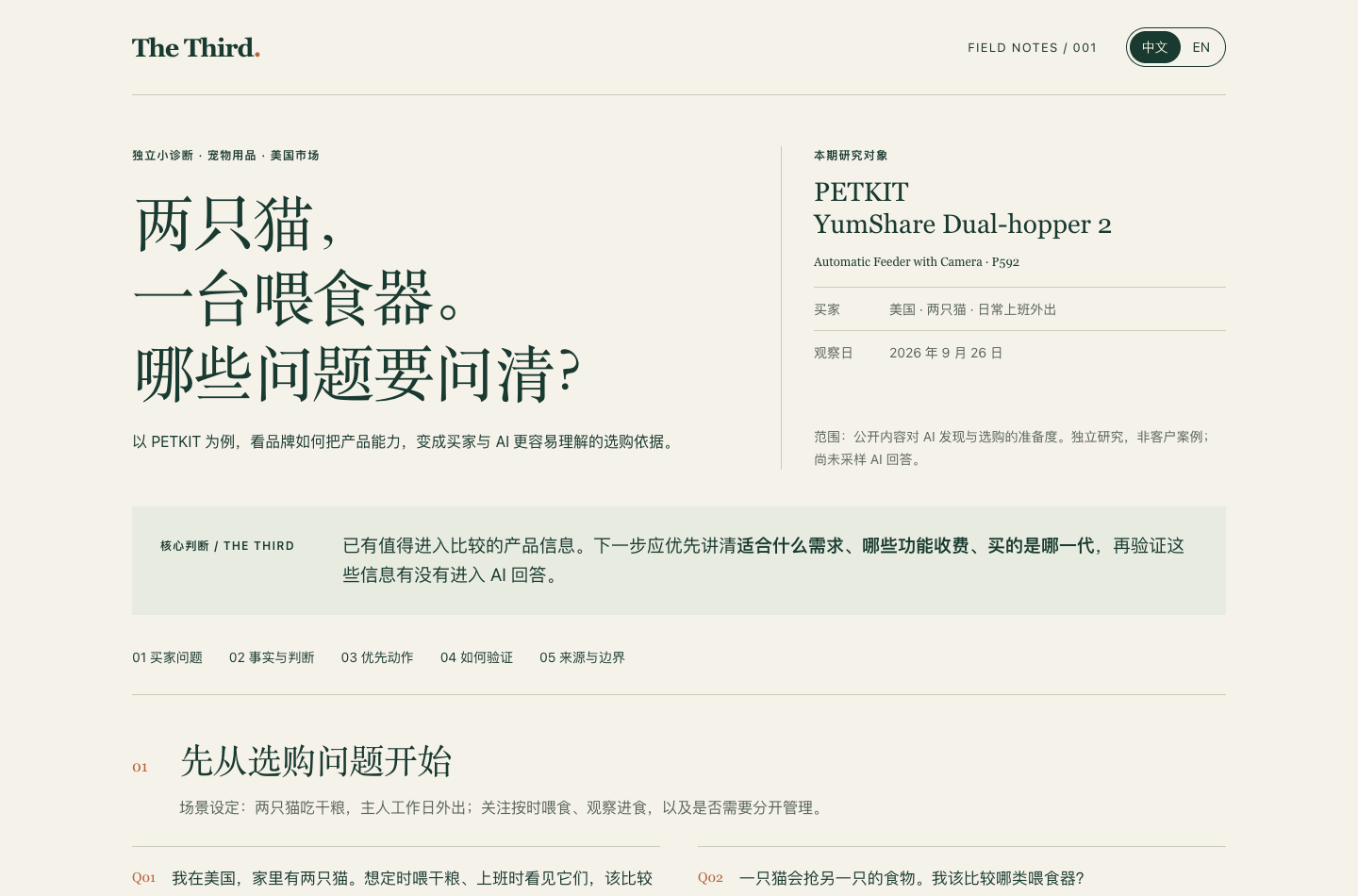
04 / 公开研究 · FIELD NOTES 001
PETKIT · YUMSHARE DUAL-HOPPER 2
从一个美国多猫家庭的选购问题出发,我们对照产品页与官方资料,发现需要进一步说清的适用条件、订阅权益和型号信息。
阅读完整诊断↗独立公开研究,非客户案例。2026-09-26。未采样 AI 回答,未声明增长成果。
05 / 一个清楚的开始
从你的业务目标、网站和市场开始,一起确认合适的服务范围。
约定问题集、竞品与采样范围,人工判断后给出优先行动计划。
按项目范围报价落实页面、内容与技术改进,建立可信来源,并持续复测。
按项目范围报价See where your brand shows up, who appears instead, and what to improve first.
We make the agreed improvements and check what changes over 90 days.
Work with us long term to keep improving how your business appears in AI search.
04 / A NEW WAY TO CONNECT NEW
Custom plugins for ChatGPT and Codex. Built around your systems, tested for real use, and maintained after launch.
Connect your product data, APIs, and accounts.
Check real tasks, permissions, and failure cases.
Monitor performance, fix issues, and manage updates.
05 / BUILT FOR PERSONAL AGENTS NEW
Let personal AI agents discover your products, use your services, and buy on their users’ behalf—with permission.
Integrations and payments are scoped to each platform’s available capabilities.
Make product details, pricing, and availability readable by agents.
Connect services and accounts so agents can book, subscribe, or complete tasks for customers.
Enable authorized checkout and payments, with clear order and delivery status.
04 / FAQ
Start here. Explore our full guide for practical answers on GEO, AEO, and working together.
Browse all ↗GEO means generative engine optimization; AEO means answer engine optimization. Both are used for work that helps a business appear accurately in AI answers. SEO addresses search visibility more broadly. The work overlaps; the labels do not define three completely separate systems.
Read the full answer ↗Usually, one coordinated plan is more useful than two plans organized around acronyms. Separate the work when the customer journey or technical requirements differ, not simply because one supplier calls it GEO and another calls it AEO.
Read the full answer ↗Start with a customer decision, not a target score. Choose a product or service, a market, and the questions people ask before buying. Then check whether your public information helps someone make that decision.
Read the full answer ↗A good search position does not explain every recommendation. First compare the actual question and answer: the competitor may better match the stated location, budget, use case, or evidence requirements.
Read the full answer ↗No. We can agree on work, reviewable evidence, and reporting. We cannot promise a fixed recommendation rate, ranking, or number of leads from an AI platform.
Read the full answer ↗Keep shared brand facts consistent, but adapt the customer questions and supporting evidence to each market. Language and location are separate variables; translating a page does not establish local relevance.
Read the full answer ↗Track discovery, accuracy, and business actions separately. Brand mentions show whether you enter an answer; citations identify sources explicitly referenced in it; recommendation context shows how you are presented. Relevant visits and qualified inquiries address a different question: did people take a useful next step?
Read the full answer ↗No. A mention names the brand. A citation explicitly references a source in the answer, usually with a link. A recommendation presents the brand as suitable for a need. A negative comparison can contain a mention; citing your research does not necessarily recommend your product.
Read the full answer ↗Check the denominator before comparing the score. “Share of all usable answers” and “share of answers that mention any brand” measure different things. Questions, platforms, markets, dates, and collection methods must also be comparable.
Read the full answer ↗Begin with customer tasks and constraints, then separate branded from unbranded questions. A test that puts your name in every prompt tells you little about whether new customers will discover you.
Read the full answer ↗There is no single prompt count that makes every report representative. A small snapshot can reveal a specific factual error or missing answer. It cannot establish your share of all real customer searches.
Read the full answer ↗The product interface and an API call may use different settings, retrieval tools, context, or model choices. Even the same question can produce different answers. Label the collection method rather than presenting every sample as what all users see.
Read the full answer ↗Compare a stable set of questions under documented conditions and keep a dated change log. If the questions or scoring rules change, separate that effect from any change in the answers.
Read the full answer ↗No. Visibility, visits, and revenue are separate outcomes. A customer can discover you in an AI answer and later arrive through branded search or a direct visit, leaving no clear AI referral trail.
Read the full answer ↗A permissive robots.txt is only one check. The actual page may be blocked by a firewall, require login, return an error, or fail to expose important information in its response.
Read the full answer ↗OpenAI documents search crawling and training crawling separately. OAI-SearchBot is for search; GPTBot is for training. You can allow the former and disallow the latter. Those permissions are not interchangeable.
Read the full answer ↗Neither is a universal switch for AI visibility. Google says it does not require special AI schema and ignores llms.txt for Search. Accurate structured data can describe your page; it cannot substitute for useful information on it.
Read the full answer ↗More questions are useful only when they answer different, worthwhile customer needs. Our editorial rule is one real decision per answer, with a clear conclusion, conditions, and supporting evidence where needed.
Read the full answer ↗Start with evidence your business is well placed to explain: product limits, documented tests, real implementation choices, or patterns from customer questions. A narrow, verifiable finding can be more useful than a broad opinion with no basis.
Read the full answer ↗Your website explains your claims; relevant outside sources can provide independent context. Start by inspecting sources that actually appear in the customer answers you care about rather than pursuing mentions everywhere.
Read the full answer ↗First identify the incorrect claim and any identifiable or listed sources. Check whether those sources actually support it. Correct the authoritative information you control, then address outdated third-party pages where possible. A factual correction should be precise enough to verify.
Read the full answer ↗Volume is a production choice, not a visibility strategy. Generate a page only when it contributes something useful that an existing page does not already cover. Review claims and remove duplication regardless of how the draft was written.
Read the full answer ↗Share your website, target market, and the question you most want to answer. We discuss scope, timing, and the evidence you need before any audit work starts.
Read the full answer ↗Ninety days is a working period, not a deadline by which an AI must recommend you. The project should produce agreed improvements, records of what changed, and a review of what the available evidence shows.
Read the full answer ↗An audit is useful when you cannot confidently choose what to fix first. You do not need to repeat research that is already sound; we can review an existing plan and agree on execution directly.
Read the full answer ↗The price depends on the decisions and work in scope: markets, products, research depth, technical changes, and who implements them. We agree on deliverables, timing, and price before work begins.
Read the full answer ↗Ongoing work makes sense when your products, markets, or priorities keep changing and there is a real backlog of useful improvements. A retainer should have an agreed purpose beyond sending another dashboard.
Read the full answer ↗A tool records observations; someone still needs to decide what matters and make the changes. We can fill an agreed gap in diagnosis, implementation, or review alongside your existing team rather than duplicate its work.
Read the full answer ↗We build a connection between your product and a supported OpenAI environment around a defined user task. Scope can include API integration, account permissions, task testing, deployment, and launch support.
Read the full answer ↗A working integration can break when APIs, authentication, data formats, or platform requirements change. Maintenance can cover agreed workflow checks, fixes, dependency updates, and changes to the integration.
Read the full answer ↗A plugin helps people use supported parts of your product in an AI environment. GEO and AEO help people discover and evaluate your business. Building an integration does not automatically improve search visibility or guarantee recommendations.
Read the full answer ↗Start with a valuable user task and a reliable way to read the necessary data or perform the action. We assess your APIs, account model, permissions, and operating constraints before defining the build.
Read the full answer ↗THE THIRD / A PLACE IN THE CONVERSATION